
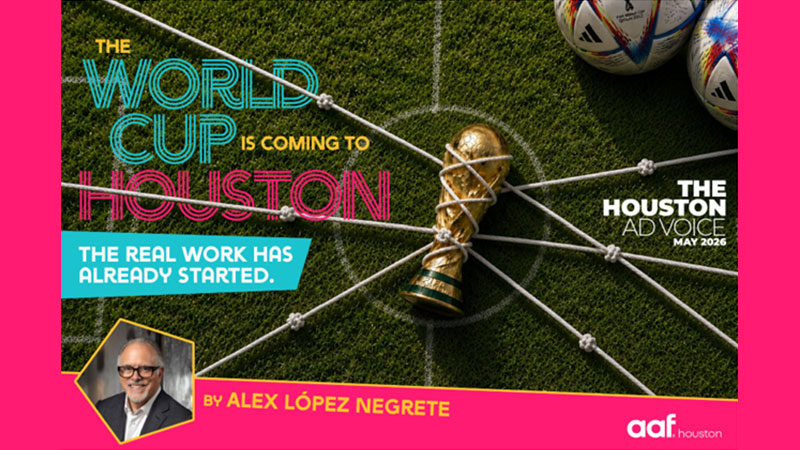
Special contribution by Alex López Negrete, President/CEO & Co-Founder of Lopez Negrete Communications.
Let me open with something honest: most global brands haven’t rolled out their World Cup campaigns yet. This is the calm before the storm — teasers, jersey unveilings, social posts. The big work is still in production, and most of it will drop closer to the tournament. Any piece pretending to inventory “what global brands are doing for World Cup 2026” today is missing the forest for the twigs.
What I can offer is perspective. Our agency has helped clients make the most of ten World Cups since we opened our doors in 1985 — and what I’ve learned across all of them is that the power of this tournament transcends geography itself.
You don’t have to be a host city, or even live in a country fielding a team, to feel it. This is the biggest sporting event on the planet, it happens once every four years, and audiences flock to watch, to cheer, to cry, to celebrate — or not. That is why soccer culture is so strong and so pervasive. Experience with it matters. And now that this tournament lives across more channels, devices, and places than ever before, that experience matters more, not less.
So here is what Houston’s advertising and marketing community should already be doing to prepare for a moment that will put our city in front of billions.
Global brands with real World Cup ambition — FIFA partners and non-sponsors alike — run a “red thread” of consistency across every market. A shared idea. A shared look. A shared anthem. But the best work also unties local knots: executions customized per region, per country, and per community, especially in countries fielding a team.
A campaign that lands in Mexico City won’t be the campaign that lands in Manchester or Madrid — nor should it be. The global brand feels like itself everywhere and feels like home somewhere.
And whether the marketer is global or local, the work cannot just be video. Unlike the Super Bowl, this isn’t about running “a spot in the game” — in fact, the in-game broadcast is protected territory available only to official sponsors. Non-sponsors don’t even have that card to play.
But the real impact of a World Cup campaign — for sponsors and non-sponsors alike — lives in the summary of touches, not in any single thirty-second placement.
The tournament is a month-long cultural residency, a sustained presence across every channel a consumer touches: social, digital, retail, out-of-home, experiential, earned, owned, paid, CRM, the whole map. That requires a communications architecture defined and designed before anyone enters production.
Skip that step, and you’ll end up with a beautiful TV spot marooned on an island while the rest of the tournament happens somewhere else.
Two World Cups ago, for a major retail client of ours, we built a library of match-day content tied to the specific countries playing on a given day — so an Argentine fan walking past a storefront or scrolling through a feed on Argentina’s match day saw work that reflected their moment.
It took enormous preparation, and it carried real risk: some of the countries we built content for didn’t make the cut, others got eliminated early. But the payoff in fan connection was priceless — and the media and traffic teams earned their stripes in the process.
The lesson: relevance at the World Cup isn’t just cultural, it’s calendrical. If your architecture can’t flex to match day by match day, country by country, you’re leaving the most emotional real estate of the entire tournament on the table.
You don’t have to be an official sponsor to show up. The tournament is the stage, but the living rooms, the taquerías packed three-deep at the counter, and the neighborhood bars with scarves draped over the TVs are available to any brand willing to reflect the moment with cultural fluency.
Our agency sits across the entire sponsorship spectrum on this one. Hyundai is a FIFA global partner and has us in constant motion right now.
Bank of America is an Official USA Sponsor, and that account is keeping us equally busy.
We just wrapped production on H-E-B‘s World Cup work.
Scott’s Miracle-Gro and Total Wine & More round out the roster as cultural participants — no FIFA patch, but plenty of cultural currency to spend.
Every one of those assignments presents the same creative gauntlet. The work has to look uniquely theirs — not like an agency swapped logos across executions. It has to cut through the sea of sameness that will flood every ad break in June and July. It has to have the legs to run for a full month, because the World Cup isn’t a one-weekend event. And it has to honor soccer culture, because the audience will know, instantly and unforgivingly, if it doesn’t.
That is the actual job.
Inside the Hispanic market, soccer doesn’t need cultural explanation. It already lives there — in the abuelita who can name a starting eleven from 1986, and in the kid wearing a Chicharito jersey to his cousin’s quinceañera. Hispanic fans are consistently among the highest-anticipation audiences for 2026.
But the cultural moment is bigger than the Hispanic audience. The World Cup is a soccer tournament the way the Super Bowl is a football game — technically correct, almost beside the point. It’s emotion, conversation, ritual, family, barrio, memory, and future at once. On every screen in the country. For a month.
Houston is one of sixteen North American host cities, staging seven matches. Seven Super Bowls’ worth of attention, compressed into a single tournament, in a single city.
But before we celebrate the scale, it’s worth remembering how we got here.
FIFA didn’t hand host status to anyone. The criteria were rigorous: a thriving soccer fan base and culture; a future-looking fan base where the sport can continue to grow; the infrastructure and transportation capacity to host a mega-event well beyond the stadiums themselves; and a human rights track record that holds up to scrutiny. Houston ranked high across every one. We earned our place on this stage.
Which is exactly why our work needs to earn its place too. How Houston shows up — on a phone screen in a San Antonio bar, on a living-room TV in São Paulo, on a stadium jumbotron in New Jersey — shapes how the world understands American culture in 2026.
If Houston earned its spot on the global stage, the marketing coming out of this city should honor the same standard.
Start now. Not in June. Now.
Build the red thread where you’re global. Tie the local knot where you’re regional. Both are required. Neither is optional.
Respect soccer culture the way you’d respect any culture. If your work would make a lifelong fan roll their eyes, you don’t have work. You have a liability.
Cross every aisle. Latino, Asian, African American, Anglo — the World Cup is the most-watched sporting event on earth, and your customer base is already watching it together. Speak to all of them, with cultural fluency for each of them.
We have a thriving, knowledgeable, thirsty, and welcoming soccer fan base in this city. We have an advertising community with the craft and the courage to meet the moment. And we have host-city status we earned — not received. What we need now is the will to start the work before the first whistle, because by the time the tournament arrives, the brands that waited will be watching it happen to them.
Be good. Do good. Have fun.
