
The Halftime Show Got It. The Ads Didn’t.
To understand what happened at Super Bowl LX, you can’t just look at the halftime show. You must look at the totality of it — everything that led to this moment and everything that surrounded it. The NFL, Jay-Z, and Roc Nation showed not just courage, but wisdom — and they showed it all day long.
Before Bad Bunny ever took the field, the NFL had already curated a Sunday that told a story of inclusion. Coco Jones represented Black culture and heritage. Brandi Carlile represented the LGBTQIA+ community. Charlie Puth represented democracy. Green Day came out with their decidedly anti-fascism statement and style. Each performance was stunning, tasteful, and deliberate. The NFL read the room, read the moment, and programmed accordingly — and they did it under real pressure.
After Kendrick Lamar’s culturally powerful halftime a year earlier, who else could possibly headline without being a step down? Bad Bunny was the answer — and a brilliant one. Commissioner Goodell openly supported the choice, even under significant heat from the White House. To me, this is akin to a CEO being supportive of the efforts of the CMO and the marketing team — and being willing to state this support during an earnings call. That constancy of message spoke loudly to Latinos across America, and to anyone who believes in unity and open-mindedness in a time of division.
The NFL didn’t just book an artist — they acknowledged the size, power, and cultural influence of the American Latino community and the halo and global diaspora that comes with it. Bad Bunny was at the center of it, but the decision was much larger than one (brilliant) performer.
And it landed.
Regardless of your Latino background — Boricua, Mexican, Dominican, Central American — you showed up for this moment. And show up we did. The Apple Music Super Bowl LX Halftime Show audience reached an average of 128.2 million viewers, according to Nielsen; and, according to NBC Sports, it generated over 4 billion social views in the first 24 hours – up 137%, making it the most-consumed halftime show of all time on NFL social platforms.
But what they witnessed wasn’t a performance — it was a cultural proclamation told through masterful storytelling. Walking through fields revealing hard-working jíbaros, climbing electric poles symbolizing Puerto Rico’s battered power grid, a real wedding on the field, a cañita with Toñita, the camera finding a family watching the Grammys on TV as Bad Bunny hands a little boy his award.
And if you’re Latino, you recognized the moment when he woke a child asleep across three chairs at the wedding — because you’ve lived that.
These details matter. They resonate. They send a loud message: we see you, we understand you. That’s what any marketer wants — far more than a guffaw that fades by Monday. Humor has a short shelf life; cultural relevance endures.
And that’s the lesson here for any marketer who wants to connect with Latino or any multicultural audience: culture lives in the details. The specific visual cues, the rituals, the textures of daily life. This requires experience, knowledge, and yes, courage. Get those details right and you earn something no amount of media spend can buy — genuine connection.
Bad Bunny never tried to cross over in the traditional way — no English verses, no collaborations designed to capture a general market audience. He makes music as if only Puerto Ricans were listening. And 128.2 million people of all walks of life tuned in anyway.
Authenticity won. Not translation.
Contrary to the narrative, this wasn’t an all-Spanish show. Lady Gaga’s performance — a highlight — was in English. Ricky Martin sang, in Spanish (remember, early in his career he had to perform in English in order to cross over into the American mainstream — even though Spanish was always his core musical language and was always considered a renowned salsero). The show honored the broader musical and cultural history that led to this moment. It was inclusive by design, not exclusionary.
Now, the ads.
Credit where credit is due — there was strong work in this year’s lineup. Largely well produced, well crafted, well directed. And not every brand is built for the kind of cultural connection I’m describing — I get that.
There were bright spots for Latino presence: e.l.f. Cosmetics committed to a full telenovela-style execution featuring Melissa McCarthy alongside novela icon Itatí Cantoral and Nicholas Gonzalez — a real creative choice, not just a casting decision. Sofía Vergara brought her customary charm across three spots for Boehringer Ingelheim, Skechers, and Telemundo — the latter leaning into the moment with cultural fluency as she helps Owen Wilson “speak fútbol.”
The standout to me was Rocket Mortgage/Redfin’s “America Needs Neighbors Like You.” This was the one marketer that dared tell a culturally salient, timely, and powerful story — crafted with sensitivity, humanity, and real storytelling craft. It was among the best work of the night from any perspective, and proof that connecting to the cultural moment wasn’t just possible, it was powerful. This is hard-working work that will endure.
But largely, when you look at the totality of the work against the totality of the moment, an opportunity was missed. Most ads existed in a cultural vacuum, disconnected from what was unfolding around them.
According to iSpot, 36% of ads leaned on nostalgic elements — music from the ’70s through the 2000s. Some of this may reflect Gen Z romanticizing an era they never lived through but can access through the internet. It’s a trend worth watching: what does it signal when the largest, youngest generation is pining for a simpler, pre-pandemic, pre-AI time?
Nostalgia can be powerful medicine, indeed. But when 36% of the ads are reaching for it, it stops being a strategy and starts becoming wallpaper.
The market data makes the missed opportunity impossible to ignore. According to Luminate, a third of American pop music fans now listen to music in Spanish. Latin music gets about as many streams as country music — in the United States.
Ad Age flagged that Hispanic representation actually waned in Super Bowl ads this year — at precisely the wrong time.
ThinkNow Research data (n=1,500) confirms it: 66% of Hispanics said they’d more likely remember a brand using Spanish-language music in a Super Bowl ad, and 49% of the total market said reggaeton would make a brand feel more relevant.
The appetite was there. The creative wasn’t.
How did so many others avoid the moment? The entity with the most to lose — the NFL itself, under direct pressure from the highest levels — was the one that leaned in all day. The advertisers, with far less at stake, played it safe.
Were they scared? Or simply unable to see that the New America has Latinos on center stage — literally and figuratively?
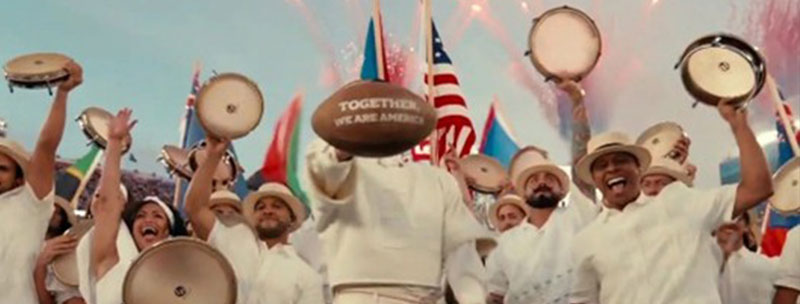
At the very end of his show, Bad Bunny named every country in our continent. Then he held up a football.
On it: Together We Are America.
Marketers, take note. Then take it to the bank.
Source: MMR News
